

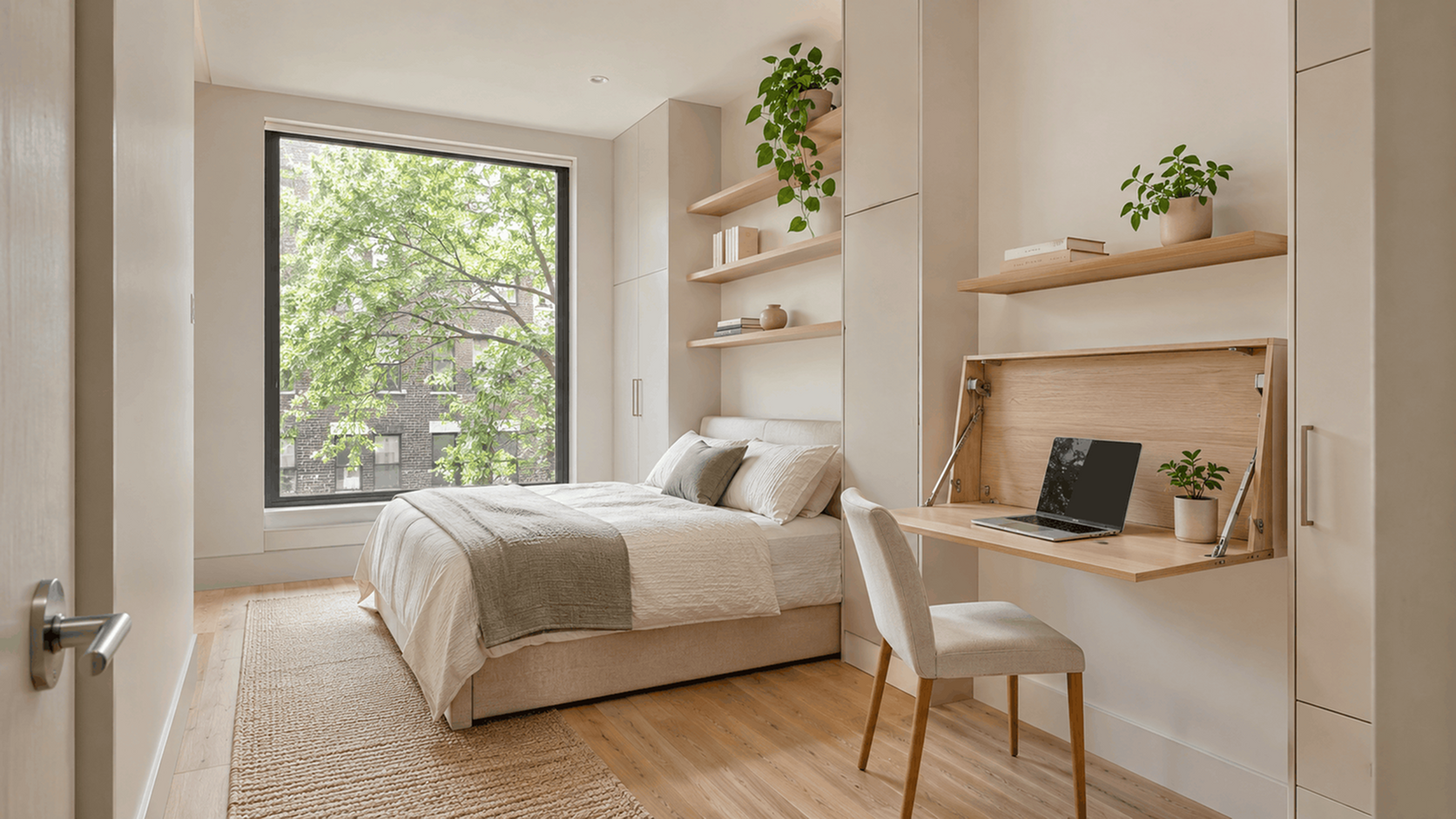
Quick Answer: Micro apartment living means renting a private, self-contained unit of roughly 350 square feet or less. Micro apartment living suits solo renters who spend most of their day out and want a central address for less than a typical studio costs. It's a tough fit for couples, remote workers and anyone who owns a lot of gear.
Nearly three in ten U.S. households are now one person living alone, and developers have answered with smaller and smaller units. Micro apartment living looks efficient on a floor plan. Whether it works in real life depends on how much time you actually spend at home. This guide covers who thrives in a micro unit, who tends to regret the lease, and when a full studio, like the gated studio homes at The Fusion at Rye 3030 in Houston's Westchase District, is the smarter call.
What Is Micro Apartment Living?
Micro apartment living is renting a private unit, usually around 350 square feet or smaller, with its own bathroom and a compact kitchen. No national legal definition exists. The Urban Land Institute describes micro units as typically about 350 square feet, though the range runs from under 250 square feet to 500 square feet depending on the city.
Planners at the American Planning Association generally reserve the label for new apartments under 400 square feet. Market researchers draw the line elsewhere. A StorageCafe analysis of Yardi Matrix data counted anything at 441 square feet or smaller and found that 14 percent of San Francisco's existing apartment stock falls under that mark.
Design does a lot of the heavy lifting. Expect Murphy beds, fold-down tables, tall ceilings and storage built into every wall that can hold it.
Why Micro Units Keep Showing Up
Household size explains most of it. The U.S. Census Bureau reported in December 2025 that the country had 39.7 million one-person households, 29 percent of all households, up from 20 percent in 1975. More people living alone means more demand for small, private units close to work. Micro units fill that gap in cities where a standard one-bedroom is out of reach.
Who Is Micro Apartment Living Right For?
Micro living works best for people who treat their apartment as a base rather than a hangout. If you're at work, the gym or out with friends most evenings, you rarely miss the square footage you gave up. The location and the lower monthly bill usually matter more than an extra 150 square feet you'd barely use.
Renters Who Tend to Thrive
- Solo professionals who want a short commute to a dense job center
- Graduate students who mostly sleep and study at home
- Traveling nurses, consultants and rotating workers who need a reliable home base
- Minimalists who already own very little and like it that way
Who Should Skip Micro Unit Apartments
Couples feel the squeeze first. A few hundred square feet leaves no room to be apart, and most micro units are designed and leased with one occupant in mind. Remote workers struggle too, because a fold-down table is a poor substitute for a real desk eight hours a day.
Then there's stuff. Bikes, musical instruments, a home gym or seasonal wardrobes all compete for the same few closets. Pet owners should think hard as well, since a larger dog needs floor space that a 300-square-foot unit simply doesn't have.
One honest caveat: living alone doesn't automatically make you a micro-unit person. Plenty of solo renters work from home or cook every night. Is that you? A traditional studio will probably feel far less cramped by month three.
Studio vs Micro Apartment: Is Micro Apartment Rent Really Cheaper?
Micro apartment rent is usually lower per month but higher per square foot. Matthews, a commercial real estate brokerage, estimates micro-unit rents at roughly 20 to 30 percent below a market's average studio rent. You pay less in total, yet every square foot costs more, so the real question is whether the space you give up was worth paying for.
One Seattle micro unit profiled by the National Apartment Association rented for $750 a month. That works out to $5.77 per square foot, against $2.60 per square foot for an average studio in the same neighborhood. Published averages vary widely by city and provider, so treat these as directional rather than local quotes.
| Factor | Micro Apartment | Traditional Studio |
|---|---|---|
| Typical size | About 350 sq ft (under 250 to 500 by city) | Often 450 to 600 sq ft |
| Monthly rent | Roughly 20 to 30% below local studio average | Local market baseline |
| Rent per square foot | Usually higher | Usually lower |
| Furniture | Built-in or fold-away pieces | Room for a standard bed, sofa and table |
| Working from home | Difficult day to day | Space for a dedicated desk |
| Best fit | Solo renter who is rarely home | Solo renter who lives, works or cooks at home |
Run the 30 Percent Check First
HUD's long-standing affordability guideline treats a household as cost burdened when housing costs top 30 percent of income, and HUD's PD&R Edge explains how that measure works and where it falls short. Count utilities in that figure, not just base rent. A micro unit with separate electric and internet bills can end up costing close to an all-bills-paid studio. At The Fusion at Rye 3030, rent and utilities are rolled into one monthly payment, so you can compare studio floor plans and current pricing against any micro listing on equal terms.
Frequently Asked Questions
1. How small is a micro studio apartment?
Most fall between 250 and 400 square feet, with about 350 square feet the most common reference point. The Urban Land Institute notes that some cities, including San Francisco and Washington, D.C., allow units as small as 220 square feet. A standard studio is usually noticeably larger, so always confirm the exact square footage before you tour.
2. Is a micro apt a good choice for couples?
Usually not. Two people sharing 300 square feet have no private space, little storage and nowhere to work separately. Many micro buildings also design their units around a single occupant. Couples who want a compact, affordable home typically do better in a larger studio or a small one-bedroom where daily routines don't constantly collide.
3. How do you make small apartment living feel bigger?
A few habits go a long way in any compact home:
- Choose furniture that folds, nests or doubles as storage
- Use wall height with shelves and over-door organizers
- Keep floors clear and stick to a light, consistent color palette
- Edit belongings every season instead of once a year
4. Are micro apartments allowed in every U.S. city?
No. Each city sets its own zoning and housing code minimums, and many don't permit units below a set size. Some coastal cities have loosened those rules to encourage micro units, while lower-density markets often have none at all. Check local listings, and you'll quickly see whether micro units exist where you plan to move.
5. What should you check before living in a micro apartment?
Measure your bed, desk and largest furniture pieces before touring. Ask which utilities are included, how long the lease runs, and what storage comes with the unit. Compare the total monthly cost with nearby studios and review the in-unit and community amenities each option includes, such as internet, appliances and on-site maintenance.
Conclusion
Micro apartment living rewards renters who are out more than they're in and who value location over square footage. It can save real money each month, but you pay more per foot and give up room to work, cook or host. If your routine keeps you home, a full studio is often the better value. In Houston, The Fusion at Rye 3030 offers gated, all-bills-paid studio homes near the Sam Houston Tollway and Westpark Tollway. See the Westchase location and directions, then schedule a tour to compare the space for yourself.
